Showing posts with label garden. Show all posts

Sunday, July 10, 2011

Are Town Planners From Outer Space?

Reading Robert Guyton's recent post about a woman who dared to plant a vegetable garden on her front lawn, i am agog at the craziness of this.


Eat The View. if it's good enough for the first lady on the whitehouse front lawn, then what happened to the Oak Park, Michigan town planners?

Yes, this woman could go to jail for planting organic vegetables in her front garden. Never mind getting yourself a permit. Makes the TDC look tame by comparison!

Sunday, July 11, 2010

Zen Garden Moment


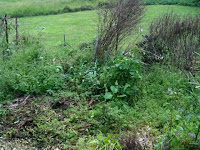
A pleasant three hours weeding the veggie garden today. I love the way that gardening connects me with mother earth, with nature and with the magic of the present moment. No past, no future, just this moment. And the next. And the next.

The ground is still very wet from a rainy few days but I wanted to prepare the beds for laying down mulch. The sooner the seedlings are planted the better. It won’t be long now before the weather starts getting warmer and before you know it, spring will be upon us.

It seems a shame to have to pull all this stuff out. I am aware of how many wild edibles have been wrenched from their homes. But hey, more will grow.

Wild edibles - the rich cousins of our more cultured leafy greens - are regaining popularity through the likes of Sergei Boutenko and our own Melbourne-based Adam Grubb. And as part of this movement towards making the most of our food supply, there's now a growing interest in the inspired act of "liberating" food through foraging. I'm thrilled to see that folk in my home town have started a group which is mapping the location of foraging spots. I'll be checking this out on my visit to NZ next month.

Scrumping is another term used to describe the recycling of fruit that would otherwise go to waste. And though scrumping is imbued with connotations of stealing, it all boils down to etiquette. If the tree branch is hanging over the footpath, well that's public property isn't it? If it is in someone's yard, then a responsible forager will knock and ask first.

More resources on foraging:
On Wild Food and Foraging - a publication distributed by Free Range Activist Network (FRAW)

Wednesday, January 7, 2009

a note about citrus


after a little bit of investigation i believe i have found some useful solutions for the vexed question of how (and if) to compost citrus.
this is something i have been asked more than once. and i've had my fair share of grief seeing orange and lemon peel add to the slush i am attempting to remediate in my own bin right now. yes, it is acidic and the worms do not like it. and, according to Paul Stamet, there is no fungi that breaks down the volatile oils, which apparently are as much of a problem as is the acidity. after all, it is the orange oil that is used as the antiseptic agent in many of the "green" cleaners to cut grease and kill living things.
however, there are other uses. you can dry the peel and use it as fuel,
in this case there's even a commercial application. not only does the dried peel burn well, but it gives off a great aroma. you can freeze the peel and then compost it. apparently it breaks down much faster, and the freezer smells great. however the following three stage juice pulp composting recipe - from the Permaculture Discussion Forum - takes the cake for the most innovative solution:

Re: Composting citrus?
by Ichsani » Sun Sep 21, 2008 1:42 pm
Hi all
After my first attempts at juice pulp composting ended in rank, pongy failure
:puke:
I hit upon a recipe that worked- found through lots (did I say lots?) of trial and error-

1 part pulp (citrus mainly, some vege and other fruits)
1 part coffee grounds a couple of handfuls of rich soil/old compost/ leaf litter etc
some token handfuls of lime (for later)
lots of microbes and wormies (free!)
the luck of the compost faeries (with us all)

I used a three stage process - involved, but it worked better than anything else I tried.
Stage 1:
The pulp and coffee came in garbage bags when I got them - either way, mix the pulp, coffee and those handfuls of soil in one bag (it really doesn't work without this step - the coffee has effectively been heat sterilised and the pulp doesn't have many microbes in it - cause the inside of the fruit doesn't - or shouldn't. When I mixed bags without the soil/old compost added, the coffee/pulp 'mummified' and didn't break down for yonks).
Don't add any water - just the pulp, coffee and soil/old compost innoculent.

The bags can't be so full else they'll tear. After mixing twist the bag shut so there's little air and turn over so its doesn't come undone - you can stack up several bags this way. Leave in a shady spot for at least a few weeks (no sun, not even a bit - another lesson learnt).

Stage 2:
When you have enough to make a pile (mine were ~1/2 cubic metre) slice open the bags - they'll be a little whiffy but only slightly. Its not a 'knock you over' kind of pong. The coffee bits look more 'fluffy' and the pulp looks pretty much the same but the smell is 'different' to when it went in ..... don't put it on plants 'to finish off in the garden' at this stage - it'll kill seedlings and such as there is a bit of alcohol produced.

Make the pile as big as you can comfortably turn (or use one of those tumbler things for bigger jobs). I did mine in compost bays open onto the ground (this helps for stage 3).

For each bag you add, chunk in a handful of lime (its nowhere near enough lime to neutralise the acidity of the citric acid 'in theory' BUT the theory strictly only holds for an acid and an alkali by themselves....and can't account for the diversity of molecules that make up the pulp and coffee, the wonders of life, microbial succession and all that guff.
Mix the pile around and sprinkle with water - moist not sodden is the aim.
You can add some leaves or straw at this point to make the finished compost less dense but try without first then adapt the mix how you see fit next time.

Fork it around a few times a week, sprinkle with water to keep it moist. It'll get HOT after each forking. This went for about 4 weeks depending on the season and the number of times I turned it. When the pulp doesn't look like pulp any more and it doesn't really get hot after turning, its time for:

Stage 3:
Either move to a finishing bay or leave in the same spot to 'finish' out of the sun. No more forking just let the worms move in. This stage takes about 4 - 8 weeks depending on the season - shorter if its warm. It also helps to cover the pile with hessian, old felt, leaves or something to keep it humid. Leave it alone except for a bit of water now and again.

That's it.

This made perhaps the best compost I have ever produced. Rich, very dark, very sticky and very very dense. It smelt wonderfully earthy and was so densely humusy that I reckon you could have modelled figurines out of it. My 1/2 cubic metre piles became about 20 buckets worth each - less than a 1/3 of the original size.

I had to cut it 70:30 (crappy sandy soil: compost) to use it. Other, more crumbly composts I grow straight into no problem - but not this one. I tried higher amounts of this compost in pots but it dried very hard and shrunk by about 1/3 and would only wet up if submerged in a bucket - hardcore compost!

If leaves, straw etc are added at stage 2 the compost comes out more fluffy and only needs a 50:50 cut.

Out of my own curiosity I tested the pH through the stages - end of stage 1 pH ~ 4, end of stage 2 pH ~ 6-7, end of stage 3 pH about 7-9. More often it was about pH 8. After cutting with (formerly) crappy sandy soil pH was ~7. Perfect.

Like everybody else here - I would rather all that organic matter goes to making us more gardens!!!!! (rather than going to landfill to make methane to warm our toes).

Monday, January 5, 2009

building a compost bin

i'm going to replace the old green plastic one with something that actually works. the unfortunate problem with the plastic bins is they don't aerate very well. once the anaerobic activity gets going it interferes with the breakdown and the organic matter starts to rot instead of composting. the other thing that can happen is not enough moisture, or too much heat. this can affect the breakdown process and the microbial action.

so the answer is to build a bin with wooden slats, have gaps between the boards to allow air to circulate and turn the compost as and when needed. a good compost that is breaking down well does NOT smell. if anything it has that rich sweet smell of live soil, and worms abound in plenty.
a lid is good though to keep vermin out, and for aesthetics.

these are some designs i am considering. placed a WANTED post on Freecycle tonight and have managed to locate some old pallets for the timber.

Vasili on SBS has detailed instructions for building a wooden compost pallet bin, including a video clip.

This three-bin structure is the rolls royce of compost bins, complete with detailed instructions and photographs. Even management students from Bucknell University can build one so it can't be that hard.

And this is my favourite, the twin bin, portable and compact. The instructions are clearly laid out, step-by-step with photos.

Watch this space as i begin to construct my own variation and combination to fit the space where the plastic bin sits.

Monday, December 1, 2008

grow food :: it's empowering

From Angela Stokes' raw reform newsletter, the trailer for the new documentary from the Dervaes family, the ‘Urban Homesteaders’ in Pasadena, California. They now have a documentary about their simple way of life – called ‘Homegrown Revolution’. I LOVE this quote in the trailer from the dad of the Dervaes family:

“...if you can grow food, it’s empowering.
In fact, I believe growing food is one of the most dangerous occupations on the face of this Earth, because you’re in danger of becoming free!”

The Dervaes family report that they grow 6000lbs of food a year on 1/10th of an acre of cultivated land...WOW...this is the future of raw foodism, folks – spade in hand – DIG FOR VICTORY ;)

Thursday, September 11, 2008

great scrumping here

i'm staying with Dad in Palmerston North, a medium-sized regional town (they call it a city) in the heart of a dairy-farming district in the North Island of aotearoa. in this suburb everyone has a lawn and a garden. most properties have trees and that just about always includes a lemon and/or a grapefruit tree. citrus is king. the trees are laden, and they hang freely over garden fences and into laneways. so not only do i have the pick of Dad's lemon tree, but also the neighbour's grapefruit. nothing like a freshly-squeezed grapefruit juice first thing in the morning.

Monday, May 12, 2008

digging it in south melbourne


saw this in the local newspaper today. it is heartening to see so many people getting into growing their own food. those raised garden beds look like fun. sounds like a good setup with both individual and community plots. will make a note-to-self to return to this garden in a year's time to see how it has grown. the Park Towers are a South Melbourne landmark. yes, they do tower above just about every other building in the suburb. and i used to live just round the corner.

Thursday, May 8, 2008

guerilla gardening

i read about it in this month's permablitz newsletter. wow. this is greenie activism with a different slant. these guys look set to take over the world, one fruit tree at a time.

guerilla gardeners claim to wage war against the neglect of public spaces, according to this UK blog. sure beats sitting at home on a saturday night. and yes, there's even a chapter sprouting up in sydney. and here are some useful tips for getting started.

Friday, April 25, 2008

i love my worms

i've arrived home to find that the caterpillars are still ravaging my green herbs, the neighbour's cat has been using the lettuce patch as a toilet (and dug up the mizuma seedlings), and i have two ripe roma tomatoes on my flailing tomato plants. margot has given me back my worm farm and i have lovingly transported it in the car from katoomba to melbourne. and lo, the worms survived the journey, but not without a damp patch of worm wee in the boot. never mind. it is wonderful to have worms again. they are my pets :-)